
What FDA approved, investigational and compounded mean
Medicine labels, pharmacy paperwork and the Peptimes Library all use the same handful of status terms. This guide explains each one in plain English, using the definitions from the agencies that set them: the Food and Drug Administration (FDA) and the Drug Enforcement Administration (DEA). Sources checked October 25, 2026; the sections on checking an approval, cleared devices and compounded GLP-1 medicines, November 1, 2026.
This page explains terms. It doesn't say whether any product is safe, effective or right for you, and it isn't legal advice. For your own medicine, ask your prescriber or pharmacist.
FDA approved
FDA approval belongs to a specific product, not to an ingredient. A company (FDA calls it the applicant or sponsor) applies for approval of its drug product. When FDA approves the application, its approval letter allows that company to market that product in the US. FDA says approval means its drug center has reviewed data on the drug's effects and decided that the benefits outweigh the known and potential risks for the intended population.
The approval is tied to the product's label, which FDA calls the official description of the drug product. The label sets out the conditions the product is approved to treat, its dosage form (a tablet or an injection, for example) and how it's given. FDA calls use outside those terms, such as for another condition or given in a different way, "unapproved use" of an approved drug.
Two things follow from this:
- Another product with the same active ingredient needs its own approval. Generic medicines, for example, are approved through applications of their own. Our guide to GLP-1 brands and their active ingredients shows this for semaglutide and tirzepatide.
- A compounded or other unapproved product doesn't share a brand's approval, even if it contains the same active ingredient.
Approved, cleared and registered
These words aren't interchangeable. "Approved" is used for drugs, and for the highest-risk (Class III) medical devices, which generally need premarket approval. Many other devices are "cleared" through a 510(k): FDA agrees the device is substantially equivalent to one already legally on the market. In FDA's words, "mere registration of an establishment or listing of a drug or device does not denote approval." So a pharmacy or product being registered with FDA doesn't make it FDA-approved.
How to check if a medicine is FDA approved
- Find the names on the box or pharmacy label: the brand name, if it has one, and the active ingredient.
- Search Drugs@FDA for either name. An approved product is listed under its application, with its dosage form, route and marketing status.
- Check that it matches what you have: the same product, dosage form and route. An approval for an injection doesn't cover a tablet, and an approved brand doesn't cover a compounded version.
- For generics, FDA's Orange Book identifies drug products approved on the basis of safety and effectiveness, with FDA's therapeutic equivalence evaluations.
Drugs@FDA (fda.gov/drugsatfda) is FDA's database of approved drug products for human use. Each application lists its products with their dosage form, route and marketing status; "Discontinued" means an approved product that isn't currently marketed, or never was. DailyMed, from the National Library of Medicine at NIH, publishes the labeling companies submit to FDA, but a listing there isn't proof of approval: it also lists some products FDA doesn't approve, such as dietary supplements. Our guide to reading an FDA drug label walks through searching both.
Investigational
FDA calls drugs that are being tested but aren't yet approved "investigational" or "experimental" drugs. Federal law generally requires a drug to have an approved application before it's shipped across state lines. An Investigational New Drug application (IND) is how a study's sponsor gets FDA's exemption from that rule, so the drug can go to the researchers running its clinical trials.
Clinical trials run in phases. Our guide to what clinical trial phases mean explains Phase 1, 2 and 3.
Compounded
FDA describes compounding as a licensed pharmacist or physician (or, at an outsourcing facility, a person supervised by a licensed pharmacist) combining, mixing or altering a drug's ingredients to make a medication tailored to an individual patient's needs. Federal law sets out two routes:
- 503A pharmacies: compounding by a licensed pharmacist or physician under section 503A of the Federal Food, Drug, and Cosmetic Act. These compounders aren't subject to FDA's current good manufacturing practice (CGMP) requirements.
- 503B outsourcing facilities: facilities registered with FDA as outsourcing facilities under section 503B. FDA is their main overseer, inspects them on a risk-based schedule and requires them to meet CGMP requirements.
"Compounded drugs are not FDA-approved," FDA says. That means FDA doesn't verify their safety, effectiveness or quality before they're marketed. This holds even when a compounded drug contains the same active ingredient as an approved medicine.
Compounded semaglutide and tirzepatide
Semaglutide is the active ingredient in Ozempic, Wegovy and Rybelsus, and tirzepatide is the active ingredient in Mounjaro and Zepbound. Those are the FDA-approved products, each for the uses on its own label. A compounded semaglutide or tirzepatide isn't one of them and doesn't share their approval. FDA's page on unapproved GLP-1 drugs says so directly: "compounded drugs are not FDA approved," and "the agency does not review compounded drugs for safety, effectiveness or quality before they are marketed."
The semaglutide and tirzepatide pages list each approved product with its source and the date it was checked.
FDA's lists for 503A compounding
Bulk drug substances (active ingredients) can be nominated for FDA's 503A bulk drug substances list. Under an interim policy, while it evaluates the nominations, FDA sorts the nominated substances into three categories. Its list of them, updated May 14, 2026, names the categories:
- Category 1: "Bulk Drug Substances Under Evaluation"
- Category 2: "Bulk Drug Substances that Raise Significant Safety Risks"
- Category 3: "Bulk Drug Substances Nominated Without Adequate Support"
A category is a compounding status, not an FDA approval: a compounded drug isn't FDA-approved, whatever category its ingredient is in. Substances move between categories when nominations change, so check the date on FDA's list. FDA has also said it doesn't intend to place substances nominated on or after January 7, 2025, into these categories (checked November 1, 2026; the list was still dated May 14, 2026).
Schedule III
The federal Controlled Substances Act places controlled substances in five schedules, I to V. DEA describes each schedule by whether its substances have an accepted medical use in the US and by their potential for abuse and dependence. Schedule III substances have an accepted medical use and less potential for abuse than those in Schedules I and II.
DEA lists anabolic steroids, including testosterone, in Schedule III, and federal regulations name testosterone in Schedule III's list of anabolic steroids (21 CFR 1308.13(f)).
What that means for a prescription, in plain terms, from DEA's manual for pharmacists:
- The prescription has to be valid. DEA says a prescription for a controlled substance must be issued for a legitimate medical purpose by a practitioner acting in the usual course of professional practice.
- Refills are limited. A Schedule III prescription can be refilled only if the prescription authorizes it, and no more than five times within six months of the date it was issued. After five refills or six months, whichever comes first, a new prescription is needed (21 CFR 1306.22(a)).
- State law applies too. Federal and state controlled-substance laws are designed to work together, so your state's rules also apply.
This is a summary of DEA's published guidance, not legal advice. Your pharmacist can tell you how it applies to your prescription. Transfers, state rules and the records worth keeping are covered in why testosterone is a Schedule III controlled substance.
In the Peptimes Library, testosterone entries show "DEA Schedule: Schedule III" with "Controlled substance · prescription only". No other Library entry shows a DEA schedule.
Dietary supplement
Dietary supplements are regulated differently from drugs. In FDA's words, "by law, FDA does not approve dietary supplements or their labeling." Under the Dietary Supplement Health and Education Act, FDA doesn't have the authority to approve supplements before they're marketed, and the companies that make and sell them are responsible for making sure their products meet the law's requirements. A product sold as a dietary supplement isn't an FDA-approved drug.
The status labels in the Peptimes Library
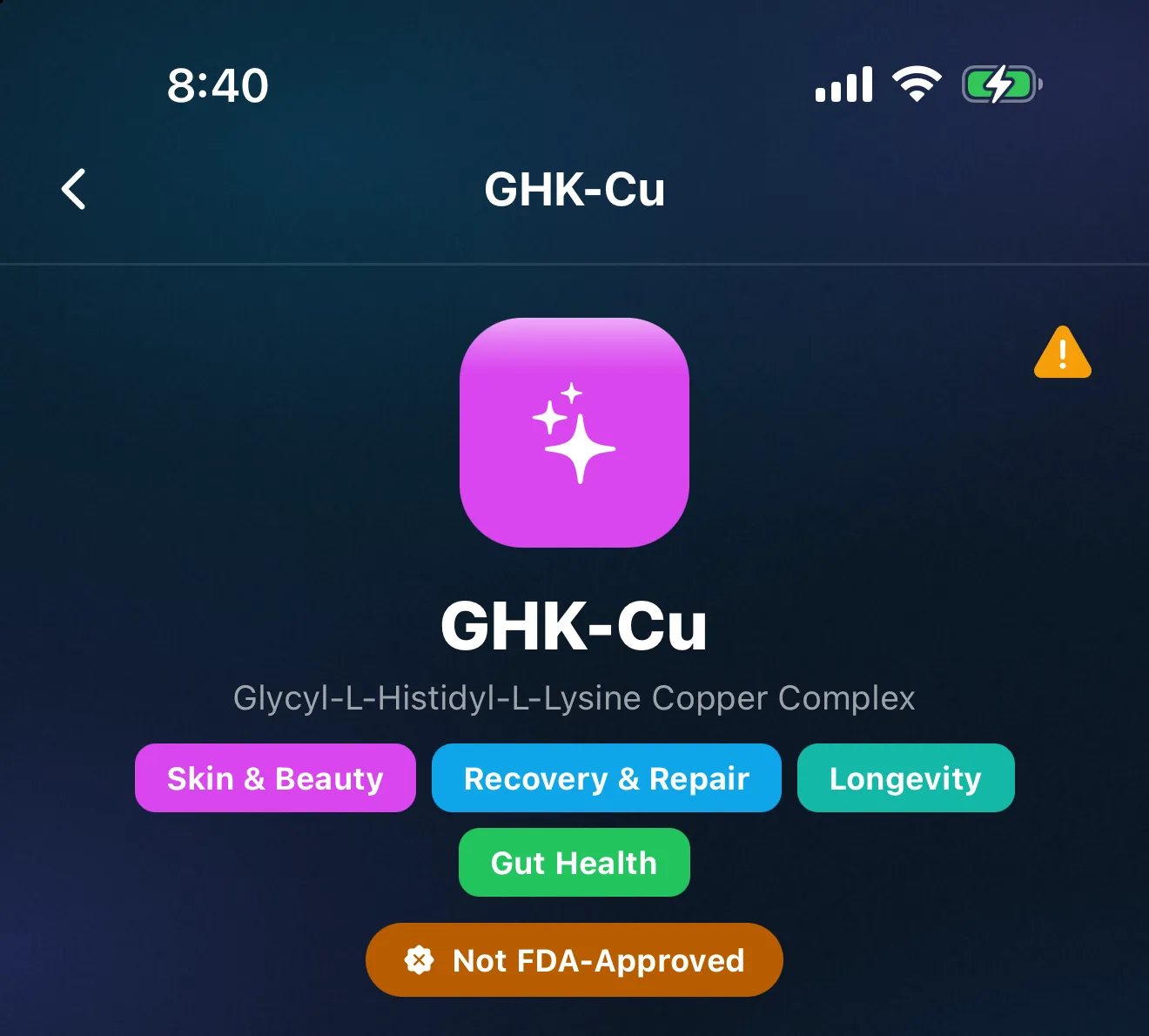
Each Library entry has its own page, with one status label at the top. The label records what the Library's sources showed for that compound. It's a starting point, and it can be out of date. Here's what each label means:
| Label | Meaning |
|---|---|
| FDA Approved | An FDA-approved product exists for at least one use. The page says which. |
| Not FDA-Approved | No FDA-approved product. |
| Approved outside the US | Approved by a regulator in another country, not by the FDA. |
| Phase 1 / 2 / 3 Trials | Investigational: in clinical trials, not FDA-approved. |
| Dietary Supplement | Sold as a supplement, not an FDA-approved drug. |
| Compoundable | Not FDA-approved as a product; FDA rules allow pharmacies to compound it. |
| Compounding Restricted | FDA lists it as raising significant safety risks for compounding (its "Category 2"). |
The trial labels name their phase: "Phase 1 Trials", "Phase 2 Trials" or "Phase 3 Trials". Further down, each Library page has an "FDA & Legal Status" section. It repeats the status (for a Compounding Restricted entry, as FDA's Category 2), and has a "Compounding" row and, for testosterone, the DEA schedule. How the Library works covers searching it and the "Your doses" card.
Status can change
FDA approves new products and new uses, approved products are discontinued, and FDA updates its compounding categories (the list of 503A categories cited here was updated May 14, 2026). DEA's list of controlled substances is revised over time, too. A status is only as current as the date it was checked.
Each compound page on this site gives the status with its source and the date it was checked. Before relying on a status, check the current source yourself: Drugs@FDA for approvals, FDA's compounding pages for compounding categories, and DEA's schedules for controlled substances.
The compound pages on this site, by label
Each compound page shows the label the Peptimes Library gives it, and the US status behind it with sources and the date each was checked. A label describes the Library entry, not the specific product you have.
Keeping your own record
Peptimes is a tracking app for the medicines and compounds you already use. You log each dose you take, get reminders at the times you set, and can export your records as CSV or JSON to bring to an appointment (how to export your records). Its Library shows the status labels above as a starting point. We don't sell peptides.
See how Peptimes works as a GLP-1 tracker and as a TRT tracker.
Questions people ask
Is compounded semaglutide FDA-approved?
No. FDA says compounded drugs are not FDA approved, and it doesn't review them for safety, effectiveness or quality before they're marketed. Approval belongs to specific products such as Ozempic, Wegovy and Rybelsus, and a compounded product doesn't share it, even with the same active ingredient. The semaglutide page lists the approved products and their sources.
Is compounded tirzepatide FDA-approved?
No, for the same reason: compounded drugs are not FDA approved. Mounjaro and Zepbound are the approved tirzepatide products. The tirzepatide page lists them with their sources.
What is the difference between FDA approved and FDA cleared?
"Approved" is the word for drugs, and for the highest-risk medical devices. Many other medical devices are "cleared": FDA agrees they're substantially equivalent to a device already legally on the market. A drug is never "cleared". And a company or product being registered or listed with FDA doesn't mean it's approved.
What is the difference between a 503A pharmacy and a 503B outsourcing facility?
Both compound drugs. A 503A pharmacy compounds under section 503A of the Federal Food, Drug, and Cosmetic Act, isn't held to FDA's manufacturing (CGMP) requirements. A 503B outsourcing facility registers with FDA, which is its main overseer, inspects it on a risk-based schedule and holds it to CGMP. Drugs from either one are not FDA-approved.
What does Category 2 mean for a peptide?
It's one of FDA's three categories for substances nominated for 503A compounding: substances FDA has found raise significant safety risks in compounding. A category is a compounding status, never an approval, and leaving Category 2 doesn't make anything FDA-approved. The Peptimes Library shows these entries as "Compounding Restricted".
How do I check if a medicine is FDA approved?
Search Drugs@FDA (fda.gov/drugsatfda) for the brand name or active ingredient, and check that the product, its dosage form and route match yours, and its marketing status. A listing on DailyMed isn't proof of approval. Reading an FDA drug label walks through it.
Sources
- FDA, "Development & Approval Process | Drugs", checked 25 Oct 2026: what FDA approval of a drug means (CDER's review; benefits outweigh known and potential risks for the intended population).
- FDA, "Drugs@FDA Glossary of Terms", checked 25 Oct 2026: the company (applicant or sponsor) submits the application; the approval letter allows marketing of the product; the label is the official description of a drug product, including its indication; dosage form; ANDA (generics); discontinued drug products.
- FDA, "Understanding Unapproved Use of Approved Drugs 'Off Label'", checked 25 Oct 2026: labeling gives the conditions a drug is approved to treat; use for another condition, or given in a different way, is unapproved use.
- FDA, "About Drugs@FDA", checked 25 Oct 2026: what Drugs@FDA covers (FDA-approved products for human use); its address, fda.gov/drugsatfda.
- FDA, Drugs@FDA search and application overview pages, checked 25 Oct 2026: search by drug name, active ingredient or application number; products listed with active ingredients, dosage form/route and marketing status, plus the company, approval history and labels.
- National Library of Medicine (NIH), "About DailyMed", checked 25 Oct 2026: DailyMed holds labeling companies submit to FDA; it includes some products FDA doesn't approve, such as dietary supplements; drugs marked "unapproved" haven't been approved by FDA; it points to Drugs@FDA for FDA-approved labeling.
- FDA, "How can I get access to a drug that is in testing but has not yet been approved?", checked 25 Oct 2026: drugs being tested but not yet approved are called investigational (or experimental) drugs.
- FDA, "Investigational New Drug Application (IND)", checked 25 Oct 2026: the IND is how a sponsor gets an exemption from the rule that a drug needs an approved marketing application before interstate shipment.
- FDA, "Human Drug Compounding", checked 25 Oct 2026: what compounding is (who does it; combining, mixing or altering ingredients to tailor a medication to an individual patient).
- FDA, "Compounding and the FDA: Questions and Answers", checked 25 Oct 2026: the quotation "Compounded drugs are not FDA-approved."; FDA doesn't verify their safety, effectiveness or quality before marketing; 503A compounders and CGMP; 503B outsourcing facilities registered with and primarily overseen by FDA, inspected on a risk-based schedule.
- FDA, "Certain Bulk Drug Substances for Use in Compounding that May Present Significant Safety Risks" (content current as of 04/22/2026), checked 25 Oct 2026: what category 2 is under FDA's interim policies.
- FDA, "Bulk Drug Substances Used in Compounding Under Section 503A of the FD&C Act" (content current as of 05/14/2026), checked 25 Oct 2026: categories 1, 2 and 3; category 2 substances raise significant safety risks in compounding.
- FDA, "Bulk Drug Substances Nominated for Use in Compounding Under Section 503A of the Federal Food, Drug, and Cosmetic Act" (PDF, "Updated May 14, 2026"), checked 25 Oct 2026: substances nominated for the 503A bulk drug substances list, in three categories, with the category titles quoted; the interim policy; the update notes showing substances moving between categories when nominations change.
- DEA Diversion Control Division, "Controlled Substance Schedules", checked 25 Oct 2026: the five schedules and how each is described; anabolic steroids, with a testosterone product as the example, under Schedule III.
- DEA Diversion Control Division, "Controlled Substances: Alphabetical Order" (dated 21 Oct 2026), checked 25 Oct 2026: anabolic steroids listed in Schedule III (the testosterone row was checked 23 Oct 2026).
- eCFR, 21 CFR 1308.13, "Schedule III", paragraph (f), "Anabolic steroids", checked 25 Oct 2026 (eCFR up to date as of 22 Oct 2026): item (84), "testosterone (17β-hydroxyandrost-4-en-3-one)", among the anabolic steroids in Schedule III.
- eCFR, 21 CFR 1306.22, "Refilling of prescriptions", paragraph (a), checked 25 Oct 2026: a Schedule III or IV prescription can't be filled or refilled more than six months after it was issued, or refilled more than five times.
- DEA Diversion Control Division, "Pharmacist's Manual" (2022 edition), checked 25 Oct 2026: Schedule III definition (p. 13) and anabolic steroids as an example; a valid prescription is issued for a legitimate medical purpose in the usual course of professional practice; Schedule III and IV refills, up to five times within six months (p. 48, citing 21 U.S.C. 829(b) and 21 CFR 1306.22(a)); federal and state laws designed to work together.
- FDA, "Questions and Answers on Dietary Supplements" (content current as of 08/27/2026), checked 25 Oct 2026: the quotation "by law, FDA does not approve dietary supplements or their labeling"; under DSHEA, FDA has no authority to approve supplements before they're marketed; firms are responsible for their products meeting the law.
- FDA, "Is It Really 'FDA Approved'?" (content current as of 05/04/2026), checked 1 Nov 2026: Class II devices marketed under 510(k) clearance (substantially equivalent to a legally marketed predicate device); Class III devices generally need premarket approval; registration or listing doesn't denote approval; compounded drugs are not FDA approved.
- FDA, "FDA's Concerns with Unapproved GLP-1 Drugs Used for Weight Loss" (content current as of 10/01/2026), checked 1 Nov 2026: the quotations "compounded drugs are not FDA approved" and "the agency does not review compounded drugs for safety, effectiveness or quality before they are marketed."
- FDA, "Approved Drug Products with Therapeutic Equivalence Evaluations | Orange Book" (content current as of 10/13/2026), checked 1 Nov 2026: the Orange Book identifies drug products approved on the basis of safety and effectiveness by FDA, with related patent and exclusivity information.
- FDA, "Bulk Drug Substances Used in Compounding Under Section 503A of the FD&C Act" (content current as of 05/14/2026), re-checked 1 Nov 2026, with the nominations list (PDF, still "Updated May 14, 2026"): FDA doesn't intend to place bulk drug substances nominated on or after January 7, 2025, into the categories.