
How to read an FDA drug label
When people talk about a prescription medicine's "FDA label", they usually mean its Prescribing Information, often called the package insert. It's written for health professionals, but almost every recent label shares one layout, so once you know it you can find your way around any of them.
This guide explains that layout, the patient leaflets that can come with it, and how to find the current version online. It covers structure only. For what your own label means for you, ask your prescriber or pharmacist.
What the label includes
FDA describes prescription drug labeling as a summary of the essential scientific information needed to use a medicine safely and effectively. It can include:
- Prescribing Information, written for doctors, nurse practitioners, pharmacists and nurses;
- FDA-approved patient labeling: a Medication Guide, Patient Information or Instructions for Use (not every medicine has these);
- carton and container labeling: the printing on the box and on the pen, vial or bottle.
Leaflets from other publishers aren't part of it: FDA notes they aren't reviewed or approved by FDA or the drug company.
The three parts of the Prescribing Information
Most current labels follow the format set out in federal regulations (21 CFR 201.56 and 201.57): Highlights, then Contents, then the Full Prescribing Information.
Highlights
A summary that fits in about half a page, plus any boxed warning. In order, it gives:
- the names, dosage form and route, and a controlled-substance symbol if one applies;
- "Initial U.S. Approval": the year FDA first approved the active ingredient (or combination of ingredients), which can be earlier than your product's own approval;
- a summary of any boxed warning;
- Recent Major Changes to the boxed warning or sections 1, 2, 4 or 5, each with its month and year;
- short summaries of sections 1 to 8, with contacts for reporting a suspected adverse reaction to the company or FDA;
- a pointer to section 17 and any patient labeling;
- the date of the most recent revision, at the end.
Read Recent Major Changes and the revision date first: they show what changed lately and how current your copy is.
Contents
A numbered list of the sections that follow. Sections that don't apply can be left out, so the numbers may skip (from 8 to 10, for example).
Full Prescribing Information
The detail, in sections whose order and numbers are set by regulation, so section 5 is Warnings and Precautions on every label in this format. Subsections are numbered within their section (5.1, 5.2 and so on), and recent major changes are marked with a line in the margin.
| Section | What it's for |
|---|---|
| Boxed Warning (unnumbered, at the top) | Serious risks FDA requires to be shown in a box. Not every medicine has one. |
| 1 Indications and Usage | The conditions the product is approved for, and any limitations of use. |
| 2 Dosage and Administration | The approved dosing, preparation and administration directions. Your own directions come from your prescriber. |
| 3 Dosage Forms and Strengths | The forms and strengths available, and how to identify them. |
| 4 Contraindications | When the product shouldn't be used because the risk clearly outweighs any benefit, or "None". |
| 5 Warnings and Precautions | Clinically significant risks, what to do about them, and any monitoring. |
| 6 Adverse Reactions | Reactions seen in clinical trials and, listed separately, those reported after approval. |
| 7 Drug Interactions | Significant interactions with other drugs, drug classes or foods, and how they're managed. |
| 8 Use in Specific Populations | Pregnancy (8.1), lactation (8.2), females and males of reproductive potential (8.3), pediatric use (8.4) and geriatric use (8.5), sometimes with more, such as kidney or liver impairment. |
| 9 Drug Abuse and Dependence | Any controlled-substance schedule, and information on abuse and dependence. |
| 10 Overdosage | What's known about overdose and its treatment. |
| 11 Description | The names, dosage form, active and inactive ingredients, and chemical information. |
| 12 Clinical Pharmacology | How the medicine works and how the body handles it. |
| 13 Nonclinical Toxicology | Laboratory and animal findings, such as on cancer and fertility. |
| 14 Clinical Studies | The studies that support the approved uses. |
| 15 References | Sources cited for important prescribing information. |
| 16 How Supplied/Storage and Handling | Package sizes, identifying features, NDC numbers, and storage and handling. |
| 17 Patient Counseling Information | What the prescriber should discuss with patients. Any FDA-approved patient labeling is printed right after it or comes with it. |
Patient labeling
- Medication Guide. FDA requires one when patient information could help prevent serious adverse reactions, when serious risks could affect a patient's decision to use the medicine, or when following the directions is crucial to its effectiveness. It's given to you when the medicine is dispensed, usually on paper, and you can ask for an electronic copy instead. FDA keeps a list of Medication Guides.
- Patient Information (a patient package insert). Required for oral contraceptives and estrogen-containing products, and optional for other medicines.
- Instructions for Use. Step-by-step written and visual directions for products that are complicated to use, covering things like preparing, giving, storing and disposing of them.
Older and over-the-counter labels
Medicines whose applications were approved before June 30, 2001 may still use an older format, with no Highlights, no section numbers, and headings in a different order (it starts with Description and ends with How Supplied).
Over-the-counter medicines use a different layout, the Drug Facts label.
How to find a label on DailyMed
DailyMed is run by NIH's National Library of Medicine. It shows the labeling that companies have submitted to FDA.
- Go to DailyMed and search for the brand name, the active ingredient or the NDC number on your package. Select Human Drugs to leave out veterinary products.
- Each result shows a title (the brand name, then the active ingredient and dosage form), its NDC codes and itsPackager. Choose the one that matches your product. List repackaged labels last puts the manufacturer's own labels first.
- On the label page, check the Category (for example, HUMAN PRESCRIPTION DRUG LABEL) and theUpdated date. Highlights comes first, then the contents, linked to each section.
- Look for the Medication Guide link near the top of the page. Other patient labeling follows section 17.
- Use Official Label (Printer Friendly) to print, and View Labeling Archivesfor earlier versions.
DailyMed notes that the labeling it shows can differ from the most recent FDA-approved version, and that FDA may not have verified it.
How to find a label on Drugs@FDA
Drugs@FDA is FDA's database of approved drugs, with their labels and approval history.
- Go to Drugs@FDA. Under Search by Drug Name, Active Ingredient, or Application Number, type at least three characters and selectSearch.
- Choose the result that matches your product's name and dosage form to open its application page.
- Check that your product is in the Products on table, with the right Dosage Form/Route.
- Open Approval Date(s) and History, Letters, Labels, Reviews. The latest Action Date with aLabel (PDF) link is the most recent approved label. A Medication Guide link appears near the top of the page when there is one.
Drugs@FDA is updated daily. It doesn't include investigational products, dietary supplements, or vaccines and blood products.
Which one to use? Drugs@FDA shows the label as FDA approved it. DailyMed shows the labeling in current use, as an easy-to-read web page. If they differ, compare their dates and ask your pharmacist.
Tips for reading your own label
- Make sure it's your product. Match the brand, the dosage form and the route. One brand name can cover several products with different labels, as our guide to GLP-1 brands and active ingredients shows.
- Check the date. Compare the revision date on the paper in your box with the version online, and take questions about a specific medicine to your pharmacist or prescriber, as FDA advises.
For what "FDA approved" covers, see what FDA approved, investigational and compounded mean.
How Peptimes fits
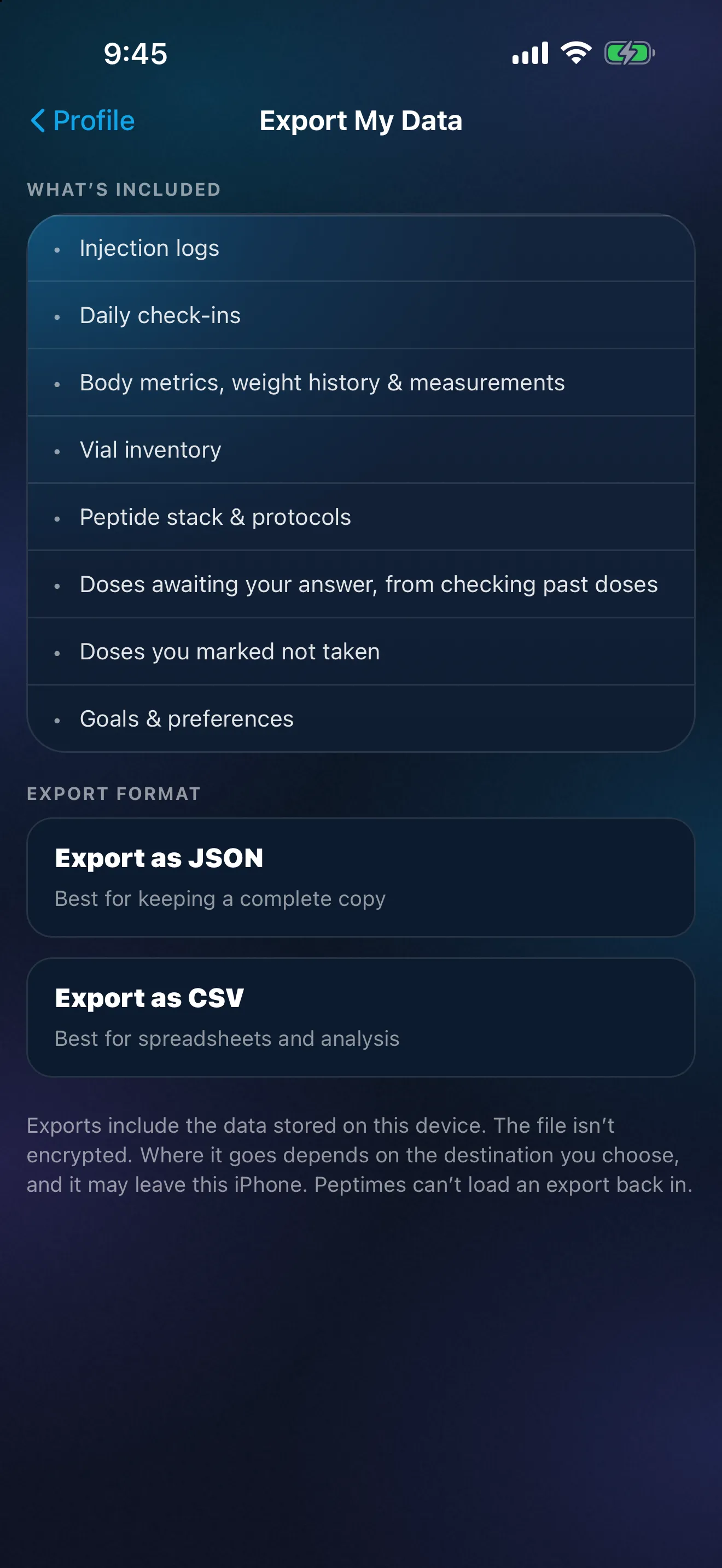
A label describes the product; your own record shows what you actually took. In Peptimes you log each dose with its amount, its route and, for injections, the site; get reminders at the times you set; and keep a daily check-in where you can note side effects and how you feel. Your health records are stored on your iPhone, and before an appointment you can export them as CSV or JSON to bring along with your questions about the label.
Exporting your records covers what to send, and preparing for your appointment covers what to bring.
Sources
- US Government Publishing Office, 21 CFR 201.56, "Requirements on content and format of labeling for human prescription drug and biological products" (annual edition revised as of 1 Apr 2025), checked 25 Oct 2026: the three parts and their order; the numbered sections and subsections; omitted sections noted in the contents; which products use the newer format (applications approved from June 30, 2001); the older format's headings. Current text: eCFR, 21 CFR 201.56.
- US Government Publishing Office, 21 CFR 201.57, "Specific requirements on content and format of labeling for human prescription drug and biological products described in § 201.56(b)(1)" (annual edition revised as of 1 Apr 2025), checked 25 Oct 2026: what Highlights contains (limitation statement, Initial U.S. Approval year, boxed warning summary, Recent Major Changes limited to the boxed warning and sections 1, 2, 4 and 5, reporting contacts, the section 17 pointer, revision date, half-page limit); the purpose of each numbered section; patient labeling printed after section 17 or accompanying the labeling; the margin line for recent changes. Current text: eCFR, 21 CFR 201.57.
- FDA, "FDA's Labeling Resources for Human Prescription Drugs" (content current as of 07/29/2026), checked 25 Oct 2026: labeling summarizes essential scientific information for safe and effective use; its components (Prescribing Information, patient labeling, carton and container labeling); DailyMed and Drugs@FDA as the key databases.
- FDA, "Frequently Asked Questions about Labeling for Prescription Medicines" (content current as of 04/01/2024), checked 25 Oct 2026: who the Prescribing Information is written for; its three parts; consumer information from other parties isn't reviewed or approved by FDA or the company; companies must update labeling that becomes inaccurate; ask a health care professional about a specific drug.
- FDA, "Patient Labeling Resources" (content current as of 08/19/2024), checked 25 Oct 2026: what Medication Guides, Patient Package Inserts (Patient Information) and Instructions for Use are, when each is required, how Medication Guides are given out; the Medication Guide list.
- FDA, "Instructions for Use: Patient Labeling for Human Prescription Drug and Biological Products: Content and Format" (final guidance, July 2022), checked 25 Oct 2026: Instructions for Use are written for patients who use the product.
- FDA, "The Over-the-Counter Drug Facts Label" (content current as of 09/02/2026), checked 25 Oct 2026: OTC medicines use the Drug Facts label.
- NLM DailyMed, "About DailyMed", checked 25 Oct 2026: run by NLM (NIH); labeling submitted to FDA; in-use labeling may differ from the most recent FDA-approved labeling and may not be verified by FDA; includes patient labeling.
- NLM DailyMed, Help, checked 25 Oct 2026: search by drug name, NDC, manufacturer, drug class or set ID; Human Drugs and Animal Drugs filters; Advanced Search.
- NLM DailyMed, a search results page and a label page (structure only), checked 25 Oct 2026: result layout (title, NDC codes, Packager, repackaged-label marker, "List repackaged labels last"); label page fields and links (Category, Updated, Medication Guide, View All Sections, Official Label (Printer Friendly), Drug Label Info PDF, View Labeling Archives).
- FDA, Drugs@FDA home page, checked 25 Oct 2026: the search box wording, the three-character minimum and browse by letter.
- FDA, Drugs@FDA Frequently Asked Questions, checked 25 Oct 2026: what Drugs@FDA includes and excludes; search by name, ingredient or application number; updated daily, new approvals usually within two business days; latest and earlier approved labeling.
- FDA, Drugs@FDA application page (structure only), checked 25 Oct 2026: the "Products on" table and its columns; "Approval Date(s) and History, Letters, Labels, Reviews"; Label (PDF) links by Action Date; the Medication Guide link; "Labeling-Package Insert" as a supplement category.
Coming soon to the App Store
See planned pricing